
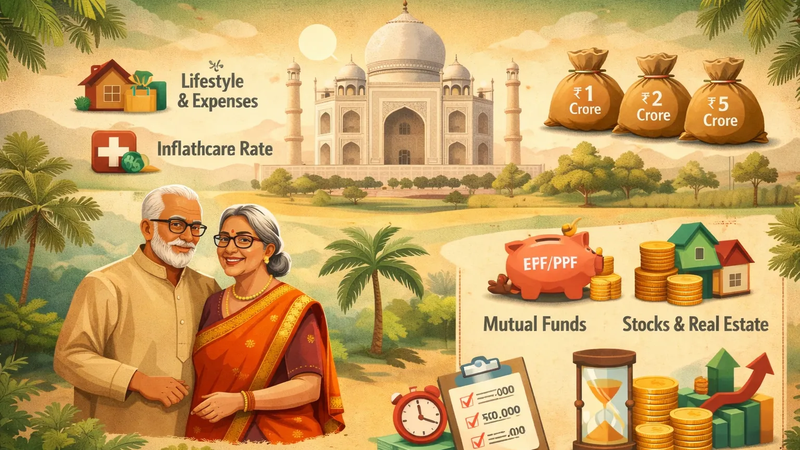
Explore how much money needed to retire in India and how much money is required to retire in India for financial security and peace of mind.
In India, retirement usually means stopping full-time work at a fixed age, most commonly between 58 and 60. It marks a shift from earning a monthly salary to living on savings, pensions, or investments.
Earlier, retirement often depended on family support. Joint families were common. Today, nuclear families are the norm. This has changed how people think about retirement.
Retirement also brings a financial shift. Income comes from sources like EPF, PPF, NPS, pensions, and personal investments. Managing these well decides how comfortable life will be later.
Key Factors That Decide How Much Money You Need to Retire in India
There is no single number that works for everyone. A common rule says you need a retirement corpus equal to 15-30 times your annual expenses. This changes based on inflation, healthcare needs, lifestyle, and life expectancy.
Current and Post-Retirement Expenses
Start with your monthly expenses. After retirement, most people need around 70-90% of their pre-retirement income to maintain the same lifestyle.
Inflation and Cost of Living
Inflation slowly reduces the value of money. In India, an average inflation rate of 6-7% can double your expenses in about 10-12 years.
Life Expectancy
People are living longer. Many retirees need their savings to last 25-30 years after retirement. A longer life means a larger corpus is needed.
Healthcare Costs
Medical expenses increase with age. Hospitalisation, medicines, and long-term care can be expensive. Many planners suggest maintaining a separate medical buffer or insurance cover of Rs 1-2 crore for life.
Investment Returns and Asset Allocation
Your investment returns play a key role. What matters is the return after inflation. Higher real returns reduce the amount of money required to retire in India.
Existing Assets and Debt
A debt-free home lowers your monthly expenses after retirement. Loans or EMIs reduce your ability to save and increase the retirement corpus needed.
Lifestyle and Personal Goals
Travel plans, hobbies, and family responsibilities, such as children's education or weddings, add to retirement costs.
Other Sources of Income
Pensions, rental income, or annuities can provide regular cash flow. These income sources reduce the lump sum required.
How Much Money Do You Need to Retire in India?
A comfortable retirement in Tier-2 cities may need around Rs 3 to Rs 5 crore. In metro cities, the number can range from Rs 6 crore to Rs 10 crore.
A commonly used method is to target a corpus equal to 15-30 times your annual expenses, adjusted for inflation.
Monthly Income Needs
If you spend Rs 50,000 per month today, you may need a retirement corpus of Rs 1.5 crore or more. For monthly expenses of Rs 1 lakh or more, the required corpus can exceed Rs 3 crore.
Impact of Inflation
At 6% inflation, expenses double roughly every 12 years. A monthly budget of Rs 30,000 today can become close to Rs 1 lakh in about 20 years.
Location Matters
Where you retire plays a big role. Living in a Tier-2 city usually costs much less than living in a metro.
Early Retirement
Retiring before 60 increases the pressure on your savings because your corpus must last much longer.
Start Early
Starting retirement planning at 30 instead of 40 can help build a significantly larger corpus through compounding.
Invest for Growth
Your investments must grow faster than inflation. Dependence on fixed deposits alone may not be enough.
Follow a Safe Withdrawal Rule
A withdrawal rate of 3-4% per year is generally considered safer for long-term sustainability.
Retirement Corpus Needed Based on Indian Lifestyle Types
The amount depends on your lifestyle and city. On average, a comfortable retirement in India may require a corpus between Rs 3 and Rs 8 crore.
Get Expert Financial Advice
Book an introductory call with our Certified Financial Planner to explore how we can help you achieve your financial goals.
Comfortable Lifestyle in a Tier 1 City
For someone around 35 years old planning a long retirement, a corpus of Rs 4.5 to Rs 5 crore is often needed.
Moderate Lifestyle in Tier 2 or Tier 3 Cities
For a similar quality of life in smaller cities, the required corpus can be around Rs 1.5 to Rs 3 crore.
Luxury Lifestyle
Luxury retirement with high discretionary spending usually requires a much larger, customized corpus, often above Rs 8 crore.
Common Retirement Planning Mistakes Indians Make
Mistake 1: Starting Too Late and Missing Compounding
Delaying retirement planning is one of the most common mistakes. Missing the early years of compounding means much higher monthly savings are needed later.
Mistake 2: Underestimating Inflation and Healthcare Costs
Many people calculate retirement needs using today's expenses and ignore long-term inflation and rising medical costs.
Mistake 3: Being Too Conservative and Avoiding Growth Assets
Putting all investments into low-return fixed-income options can reduce real purchasing power over time.
Mistake 4: Carrying Debt and Ignoring Estate Planning
Entering retirement with debt creates pressure on fixed retirement income. Estate planning with updated nominees and a valid Will is equally important.
How to Build Your Retirement Corpus in India
Step 1: Define Your Retirement Income Needs
Estimate how much monthly income you will need after retirement based on your desired lifestyle.
Step 2: Account for Inflation
Project future costs with inflation so your retirement plan reflects real purchasing power.
Step 3: Identify Your Retirement Assets
List EPF, gratuity, pension benefits, and personal investments to identify your retirement gap.
Step 4: Choose the Right Investment Mix
Use growth-oriented assets in earning years and gradually shift to safer instruments as retirement nears.
Step 5: Start Early and Stay Consistent
Starting early allows compounding to work in your favor and makes the goal easier to achieve.
Step 6: Plan for Healthcare and Emergencies
Keep health insurance and an emergency fund to protect your retirement corpus from unexpected costs.
How FinAToZ Helps You Plan Retirement Smarter
FinAToZ helps with practical, personalized retirement planning through certified advisers, risk-aligned investment strategy, and regular reviews.
Frequently Asked Questions
How much money is required to retire in India?
The amount depends on lifestyle, city, inflation, and retirement age. Many people target 25-30 times annual expenses.
When should I start planning for retirement?
The earlier you start, the better. Starting in your 20s or 30s gives compounding more time.
Is EPF and pension enough for retirement in India?
In most cases, no. EPF and pension help, but additional investments are usually required.
Can I retire early in India?
Yes, but early retirement needs a larger corpus since savings must last longer.
Get Expert Financial Advice
Book an introductory call with our Certified Financial Planner to explore how we can help you achieve your financial goals.
About the author
Ashish Vryse