
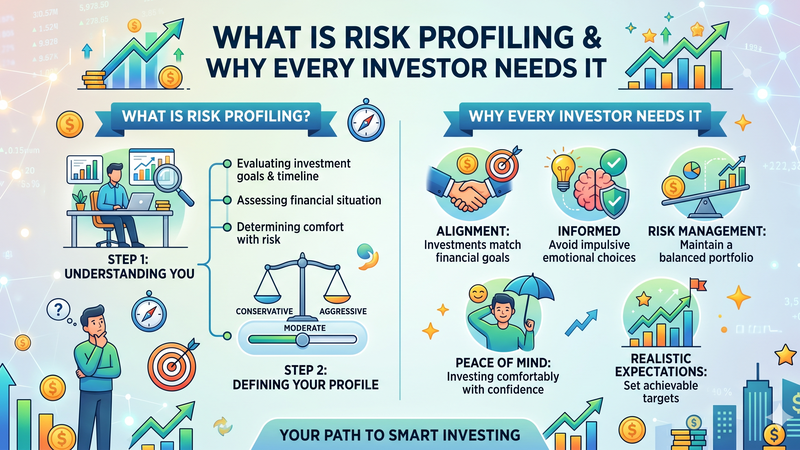
Understand why risk profiling is crucial before investing and how it helps build a balanced portfolio suited to your financial needs.
You have money to invest. You know you should start. But where do you begin?
Most people jump straight to picking mutual funds or stocks. That is a mistake.
Before choosing any investment, you need to understand your own risk profile. This single step can make or break your entire financial journey.
In this blog, we will explain what a risk profile is, why it matters, and how FinAtoZ uses it to build better financial plans for you.
What Is a Risk Profile?
A risk profile is a complete picture of how much risk you can take with your money.
It is not just about how much loss you can tolerate emotionally. It also includes your financial ability to absorb that loss.
In simple terms, your risk profile answers two questions:
- How much risk can you afford to take? (your financial capacity)
- How much risk are you comfortable taking? (your emotional tolerance)
- How much risk do you need to take to achieve your goals? (your risk need)
Both of these matter equally. A good advisor always looks at both before recommending any investment.
There is a third dimension most people miss: how much risk you have to take.
Say your goal is to build ₹2 crore in 15 years. You are currently saving ₹20,000 a month. To hit that number, you need a certain rate of return. And to get that return, you need a certain level of equity exposure. That is your risk need.
Here is why this matters. You might be emotionally comfortable with low risk. Your finances might also support a conservative approach. But if a conservative portfolio returns 6-7% and your goal needs 11-12%, you will fall short. Comfort alone does not get you to the finish line.
On the other side, some investors take on far more risk than their goal actually requires. If you only need 8% returns to meet your target, there is no reason to load up on small-cap funds chasing 15%. You are taking extra risk for no extra reward.
A good advisor balances all three: what you can handle emotionally, what your finances can absorb, and what your goals actually demand.
Why Does Risk Profiling Matter?
Think of risk profiling as a foundation. Every investment decision is built on top of it.
Without knowing your risk profile, you might:
- Invest too aggressively and panic-sell during a market crash
Get Expert Financial Advice
Book an introductory call with our Certified Financial Planner to explore how we can help you achieve your financial goals.
- Invest too conservatively and fall short of your financial goals
- End up with products that do not match your needs
Risk profiling is one piece of a larger puzzle. To understand the full picture, read the objectives of financial planning and why getting these fundamentals right early makes all the difference.
For example, a 28-year-old IT professional saving for retirement in 30 years can afford more equity exposure. But a 55-year-old approaching retirement needs a more conservative approach. Same goal, very different risk profiles.
What Goes Into a Risk Profile?
A thorough risk profile covers several dimensions. Here is what a good advisor will evaluate:
Time Horizon
How long before you need the money? Longer timelines allow for higher risk because you have time to recover from market dips.
Financial Goals
Are you saving for a house, your child's education, or retirement? Each goal has a different timeline and priority. This shapes the appropriate level of risk for each.
If retirement is your primary goal, start with the numbers. Our guide to how much you need to retire in India breaks down the corpus you need, based on your lifestyle and timeline.
Income and Savings
How stable is your income? Do you have an emergency fund? If your income is steady and you have cash reserves, you can take on more risk.
Existing Liabilities
Do you have a home loan, personal loan, or other EMIs? High debt reduces your capacity to take investment risk.
Emotional Tolerance
Some people check their portfolio every day. Others do not look at it for months. How would you feel if your portfolio dropped 20% in one month? Your emotional reaction to loss is a key part of your risk profile.
Investment Experience
A first-time investor who has never seen a market crash may overestimate their comfort with risk. Prior experience helps calibrate the assessment accurately.
Types of Risk Profiles
Get Expert Financial Advice
Book an introductory call with our Certified Financial Planner to explore how we can help you achieve your financial goals.
About the author
Ashish Vryse